

The Government of Nova Scotia committed to protecting 20 per cent of its lands and waters by 2030—a target set in law under the Environmental Goals and Climate Change Reduction Act and reaffirmed in its 2023 protected areas strategy—but advocates warn the province is no longer on track as progress stalls, putting species, ecosystems, and communities at risk.
With just four years remaining until that deadline, concerns are growing about whether the province can meet its commitment.
James Gunvaldsen Klaassen, a lawyer with Ecojustice, says “that’s a legislative goal that they have set for themselves,” but momentum has slowed “to the point where it’s possible that we may not in fact meet that goal in the province,” noting the target is already lower than Canada’s broader environmental commitment.
Canada is also a signatory to the United Nations Convention on Biological Diversity, which commits governments to protecting ecosystems and species.
“There’s been a 73 per cent decline in the average size of monitored wildlife populations across the globe, and in Canada, it is in a similar decline,” Klaassen explains. “These losses are avoidable with stewardship and with respect for nature.”
‘We are undermining our own existence by not protecting the species we share this world with’
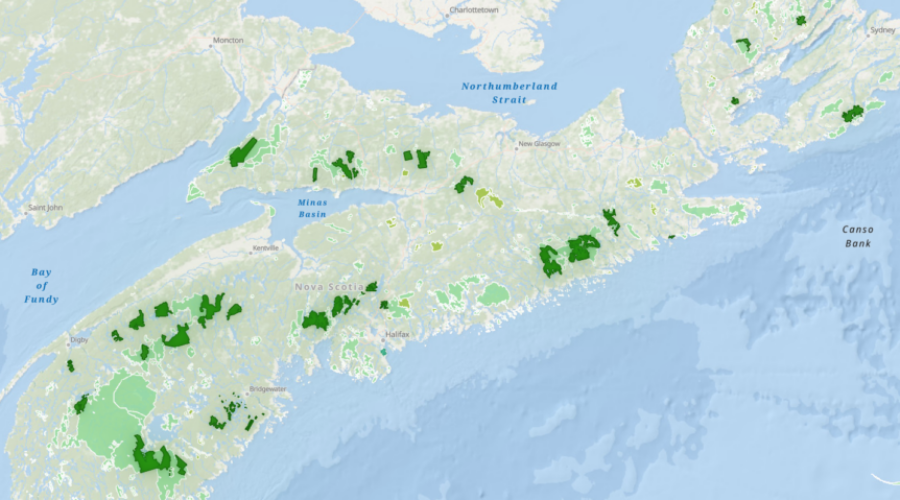
Earlier this month, Klaassen stood alongside more than 50 environmental groups in Halifax to present their concerns, announcing a new interactive online map showing which areas are protected, which should be protected, and which are under threat.
“If there is not adequate space provided for endangered species, and for the many species that make up the ecosystems in Nova Scotia, we’re going to see even more dramatic declines than we’ve already seen,” urges Klaassen.
He says these spaces are often threatened by development “which is not always done in a way that fosters survival and the maintenance of these species.”
Klaassen says his work focuses on “protecting what we have and to advocate for stronger protection and laws.”
‘It’s pretty arrogant to say they don’t matter’
The piping plover, a small shorebird found mainly in the Maritimes and parts of Ontario, is an endangered species—and recently, Ecojustice celebrated the end of a two-year court battle over its protection.
“There’re only a few hundred breeding pairs in Atlantic Canada and if we don’t protect those remaining pairs we won’t have piping plovers. It’s an iconic species, it has every right to exist just as we do, and if we don’t allow for that it will be a massive tragedy,” says Klaassen.
Other species in Nova Scotia, including wild salmon and mainland moose, are also facing significant declines, and Klaassen worries some people are still not taking issues like this seriously.
“Our whole ecosystem is built on their existence and sharing of these systems with everybody else—all the other organisms that make up the biomass of Canada, of this world—and to suggest that they’re not important is pretty short-sighted, it’s pretty arrogant.”
Klaassen says humans are deeply connected to the natural world, and ignoring that reality comes at a cost.
“We are actually undermining our own existence by not protecting the species that we share this world with,” he says. “Our existence does not operate in isolation from everything else on this planet, and without them it would be a tragic loss.”
He adds that failing to meet the province’s protection target would not only break a promise to Nova Scotians, but could also put it at odds with its own legislation.
Environmental groups say they will continue pushing to protect Nova Scotia’s lands, waters, and species—but with 2030 quickly approaching, pressure is mounting on the province to meet the commitment it set for itself.