


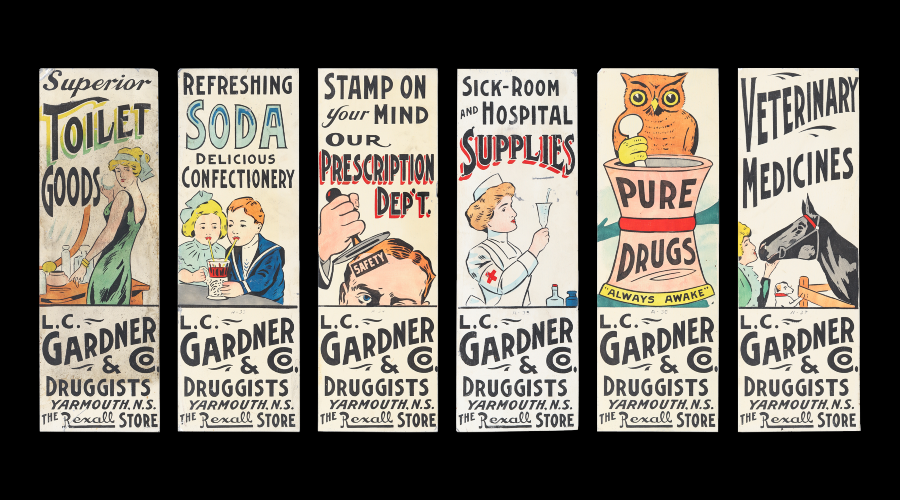
A one-of-a-kind historical artifact from Yarmouth sold at an auction for much more than you might expect.
The set of six tin signs, which are nearly 100 years old and were made to advertise a pharmacy along the road, went for $32,500 at an Ontario auction.
Nadine Gates, director of the Yarmouth County Museum and Archives, says she only learned they were on auction while scrolling social media.
“It was like, ‘Oh my gosh, that’s the L. C. Gardner. That’s from Yarmouth.’ And I just commented that it was too bad that we hadn’t known about it. We might have bid on them at this auction,” says Gates.
However, she adds that they probably could not have afforded the high price the signs earned in the end.
They were originally commissioned by Lindsey Cann Gardener for his pharmacy, called the L. C. Gardner and Druggists, sometime between 1920 and 1934, according to a social media post from Miller and Miller Auctions based out of New Hamburg, Ontario.
Not only did Gardner own that pharmacy, but he became an MLA, as well, and went on to be the Speaker of the House at the Nova Scotia Legislature. He was also the president of Minard’s Liniment, a Nova Scotia-born company that made lotion for joint pain.
The museum has some of his other items and documents, too, including a registration, the purpose of which is unknown, and some glass bottles that once held medicine.
That deep connection to Yarmouth history is partly why these signs are worth so much, says Gates.
But for collectors, this is as close to buried treasure as you can get.
Buried treasure
Ethan Miller, Chief Executive Officer of Miller and Miller Auctions, says an antique hunter found them near Edmonton, Alberta. He was going to look at a motorcycle but then someone mentioned other antique treasures and brought out the signs. The hunter paid less than $1000 for them.
Not only is it a complete set of signs, according to Miller, but they are also a cut above the others from the time.
The Ithaca Sign company was not something you would commonly see in Canada because the firm was based out of New York, he says. They were known for creating very colourful and cartoonish designs using lithography, the practice of using oil and water to transfer images onto flat objects—in this case, a set of six tin signs.
What makes them even more special is their pristine condition.
They were made to be put out on the side of the road, each one a mile apart, so that drivers would see them on the way to the pharmacy. But they are in such good shape, Miller says, that it seems they were never exposed to the elements. They would have been packaged one on top of the other in a crate. Miller says one sign appears slightly discoloured in the photos and was likely on top of the stack, which helped preserve the others even more for close to 100 years.

This all lead to rapid-fire bidding when those vintage pieces of history went to auction.
“I’ve always said you can’t brag about the money. No one will listen, but you can brag to other collectors about having something that they don’t have,” says Miller.
He adds that they don’t really go around bragging to each other, but when the demand is so high, and an item truly is one of a kind, then you get what he calls a “firework of signage.”
“Suddenly the bids go from 16 [thousand] to 17 to 18, and it was just like a heartbeat all the way through to $32,500.”